Overview
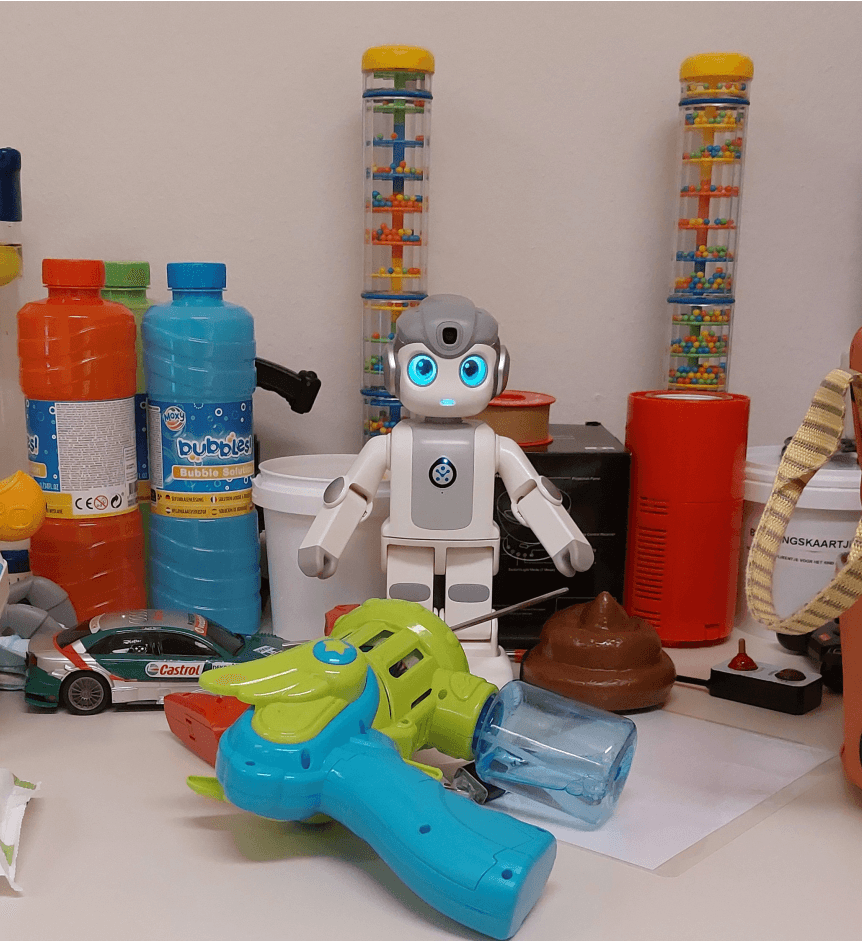
Research-assistant work at Vrije Universiteit Amsterdam from October 2024 to August 2025, on a project that puts an AlphaMini social robot in pediatric hospital settings to deliver a guided medical-hypnosis intervention before and during invasive procedures. Invasive procedures cause significant procedural anxiety in children: the immediate cost is obvious (a distressing experience) and the long-term cost is real too (anxiety carrying into adult healthcare experiences). The Dream Robot is an attempt to absorb that with something that doesn't add staff load.
Submitted to: The Dream Robot: A Social Robot for Delivering Medical Hypnosis to Children in Hospitals at ACM IDC '26 (Interaction Design and Children). Currently under review.
Where it ran
In-situ pilots inside pediatric wards during three procedure types:
- Blood draws: short, repeatable, the most common entry point.
- Anesthesia induction: the moment immediately before a child loses consciousness, the highest-anxiety pre-procedural window.
- Feeding-tube placement: longer, more invasive, requires the child to stay calm for sustained minutes.
Studies with children, parents, and clinical staff measured how each group engaged with robot-mediated hypnosis.
What the findings actually say
The headline isn't "robots help", because the more honest read of the data is conditional. Robot-guided hypnosis can support a child's coping, but only when it's aligned with three things:
- Developmental difference. What works for a six-year-old does not work for a twelve-year-old. The script and the robot's manner have to match the child.
- Procedural timing. The induction window is seconds long. Other procedures stretch over many minutes. The intervention has to be timed to the procedure, not the other way around.
- Social dynamics. A child, a parent, and a clinical professional are three people with different agendas in the same room. The robot has to fit between them, not displace any of them.
That conditional framing matters. A robot that thinks it owns the room makes parents and clinicians distrust it; a robot that's well-integrated into the team gets used.
My role
Two specific contributions, both upstream of the in-situ studies:
- Experiment design. Helping shape the pilot setup across the three procedure types and the measures used to assess child, parent, and clinician engagement.
- Coding the AlphaMini. Implementing the robot's behavior layer on the AlphaMini using the Alpha SDK: motion, speech timing, gaze, and the cues the robot uses to keep a child engaged and calm during the procedure window. This is the layer that turns a generic AlphaMini into "the Dream Robot."
The in-situ pilots and qualitative analysis were owned by other team members on the project.
Stack
AlphaMini robot (Alpha SDK), Python, study design.